
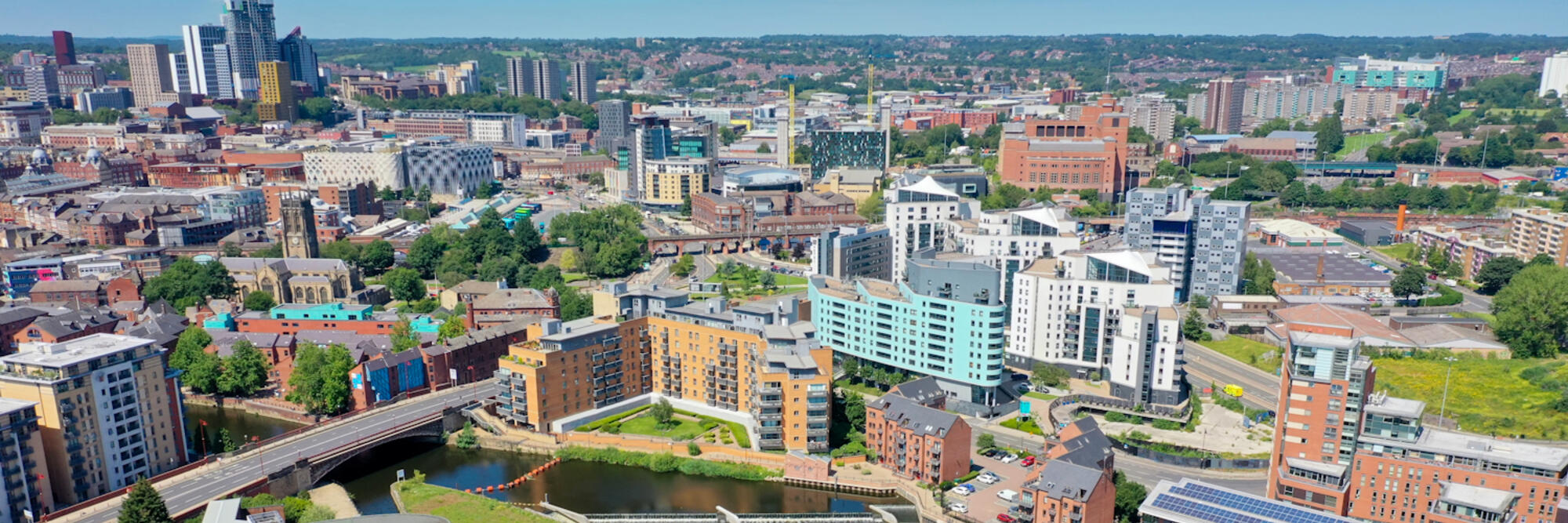
Newcomers tend to find the cost of living in Leeds a pleasant surprise. Rents and restaurant bills are far lower than in London, which is still the UK’s most expensive city by a wide margin. Leeds is the UK’s biggest hub for financial and legal services outside the capital, and professionals who relocate here get far more for their money. Day-to-day spending is roughly in line with the rest of the UK. New residents usually feel the pinch most when it comes to childcare, private school fees, train tickets, and dental treatment.
Cost of accommodation in Leeds
Rent is the biggest monthly outgoing for most newcomers, but the cost of accommodation in Leeds is well below London or Edinburgh prices. Rents here are still among the highest in the North, though. Employers in the city have hired steadily for years, so there’s been no shortage of tenants. Developers have responded with a wave of build-to-rent apartment blocks in the city centre, and landlords are now raising rents more gently than they were a few years ago.
The city centre is the priciest place to rent, and tenants who are happy to trade a longer commute for more space can save a fair bit in the outer suburbs. Council tax is another monthly bill to budget for. Leeds City Council sets the amount according to each property’s valuation band, and anyone who lives alone gets a 25 percent discount.
Since May 2026, landlords in England can ask for no more than one month’s rent in advance. That’s welcome news for expats without a UK credit history, who often had to pay several months upfront in the past. Landlords also can’t accept offers above the advertised rent, so you’ll pay the price listed and no more. Letting agents can’t charge tenants admin or referencing fees, and deposits are capped at five weeks’ rent for most properties.
Finding Rental Accommodation in Leeds
Best Areas and Suburbs in Leeds
Cost of transport in Leeds
Plenty of residents in and around the city centre get by without a car, and that’s the simplest way to keep the cost of transport in Leeds down. Leeds is one of the largest cities in Europe without a tram or metro, so most commuters rely on buses and local trains.
Single bus fares are capped across West Yorkshire, and passengers who ride every day can save more with a weekly or monthly pass. Locals grumble far less about fares than about reliability, and anyone who lives in one suburb and works in another will often have to change buses in the city centre. The West Yorkshire Combined Authority has started to bring buses back under public control as part of its new Weaver Network, and it plans to break ground on the region’s first tram lines later this decade.
Trains are the quickest way to reach Bradford, Harrogate, Wakefield, and York, but rail fares are pricey unless you book ahead. Railcards are available for several age groups and for pairs of adults who travel together, and cardholders save a third on most off-peak fares.
Car ownership is a pricier proposition. Drivers pay hefty parking charges in the city centre, and fuel prices have been volatile in recent years. Cycling is the cheapest option of all, and Leeds now has a network of segregated cycle lanes, although it’s still patchy. The best known is the cycle superhighway to Bradford. Riders who live in the northern suburbs should expect a few steep climbs on the way home.
Cost of groceries in Leeds
The cost of groceries in Leeds is a touch above the UK average, and shoppers on a budget tend to stick to Aldi and Lidl. Asda, Tesco, Sainsbury’s, and Morrisons are the main mid-range chains, while Waitrose and Marks & Spencer stock more speciality goods at higher prices.
Kirkgate Market is one of the largest covered markets in Europe, and Marks & Spencer started life there as a penny bazaar in 1884. Traders still sell fruit, veg, meat, and fish at the market for less than most supermarkets charge.
Own-brand ranges at the big chains are another easy way to trim the weekly shop, and imported goods are noticeably pricier than local produce. Tesco and Sainsbury’s keep many of their best deals for loyalty card holders, so you should sign up early.
Cost of entertainment and eating out in Leeds
Bar and restaurant owners here have a huge student market to cater to, so the cost of entertainment and eating out in Leeds is reasonable by big-city standards. You should still set aside a decent chunk of your budget if you plan to make the most of the cocktail bars on Call Lane and Greek Street or the pubs in Headingley and Chapel Allerton.
Some of the city’s best attractions are free, and visitors pay nothing to get into Leeds City Museum, Leeds Art Gallery, the Henry Moore Institute, or the Royal Armouries Museum. Theatregoers have Leeds Grand Theatre and Leeds Playhouse to choose from, and gig-goers can catch anything from arena tours to up-and-coming bands in small venues.
During the summer months, locals head to free green spaces such as Roundhay Park, Golden Acre Park, Temple Newsam, and Meanwood Park for picnics, hikes, bike rides, and leisurely strolls. Walkers can also reach the Yorkshire Dales in about an hour by car or train.
Shopping and Entertainment in Leeds
Cost of education in Leeds
State schools are free to attend, so families who go down that route can keep the cost of education in Leeds to uniforms, school trips, lunches, and after-school clubs. Leeds City Council coordinates admissions, and most schools give priority to siblings and to children who live nearby. Many parents choose where to rent with their preferred schools in mind.
You can gauge a state school’s quality from its inspection report by the Office for Standards in Education (Ofsted). Since late 2025, inspectors have graded schools on several separate areas, and they no longer award a single overall rating such as ‘outstanding’.
Independent (private) schools are mostly in the suburbs and on the city’s outskirts, and their fees are steep. Since January 2025, the government has charged VAT on those fees, and the majority of schools have passed much of that cost on to parents. Most of these schools are inspected by the Independent Schools Inspectorate (ISI) rather than Ofsted.
Childcare is one of the highest costs for young families. All three- and four-year-olds in England are entitled to some free hours at a registered nursery or childminder, and working parents may qualify for more.
Education and Schools in Leeds
Cost of healthcare in Leeds
Residents who qualify for the National Health Service (NHS) will find the cost of healthcare in Leeds low, because GP appointments and hospital treatment are free at the point of use. British citizens and residents with settled status or indefinite leave to remain are entitled to NHS care, and so are visa holders who’ve paid the Immigration Health Surcharge (IHS).
Most long-term visa applicants pay the IHS upfront for the full length of their visa, so it’s one of the higher costs to budget for before the move. Health and Care Worker visa holders don’t have to pay it.
Adults in England usually pay a flat charge for each prescription item, but anyone on regular medication can cut the cost with a prescription prepayment certificate. There’s also a charge for NHS dental treatment, and very few practices in Leeds are taking on new adult NHS patients. Many residents pay for private dental care as a result.
Leeds has several high-quality private hospitals and clinics, and their waiting lists are much shorter than the NHS’s. Treatment there is expensive without insurance, though. Many employers include private medical insurance in their benefits packages, so you should check your contract before you buy a policy yourself.
Healthcare in the United Kingdom
Cost of living in Leeds chart
Prices are listed in British pounds (GBP) and may vary depending on the product and service provider. The list below shows average prices for Leeds in November 2026.
| Accommodation (monthly rent) | |
| Three-bedroom apartment in the city centre | GBP 1,750 |
| Three-bedroom apartment outside the city centre | GBP 1,200 |
| One-bedroom apartment in the city centre | GBP 1,000 |
| One-bedroom apartment outside the city centre | GBP 750 |
| Food and drink | |
| Eggs (dozen) | GBP 3.20 |
| Milk (1 litre) | GBP 1.30 |
| Rice (1kg) | GBP 2.15 |
| Loaf of white bread | GBP 1.35 |
| Chicken breasts (1kg) | GBP 6.65 |
| Cheese (500g) | GBP 4.15 |
| Eating out | |
| Three-course meal for two at a mid-range restaurant | GBP 60 |
| Big Mac Meal | GBP 7.50 |
| Coca-Cola (330ml) | GBP 2.90 |
| Cappuccino | GBP 3.80 |
| Draft beer (domestic) | GBP 5.50 |
| Utilities/household | |
| Mobile phone monthly plan with calls and data | GBP 15 |
| Internet (uncapped fibre broadband, average per month) | GBP 33 |
| Basic utilities (average per month for a standard household) | GBP 220 |
| Transport | |
| Taxi rate (per kilometre) | GBP 1.55 |
| City-centre public transport fare | GBP 2.50 |
| Gasoline/petrol (per litre) | GBP 1.74 |