
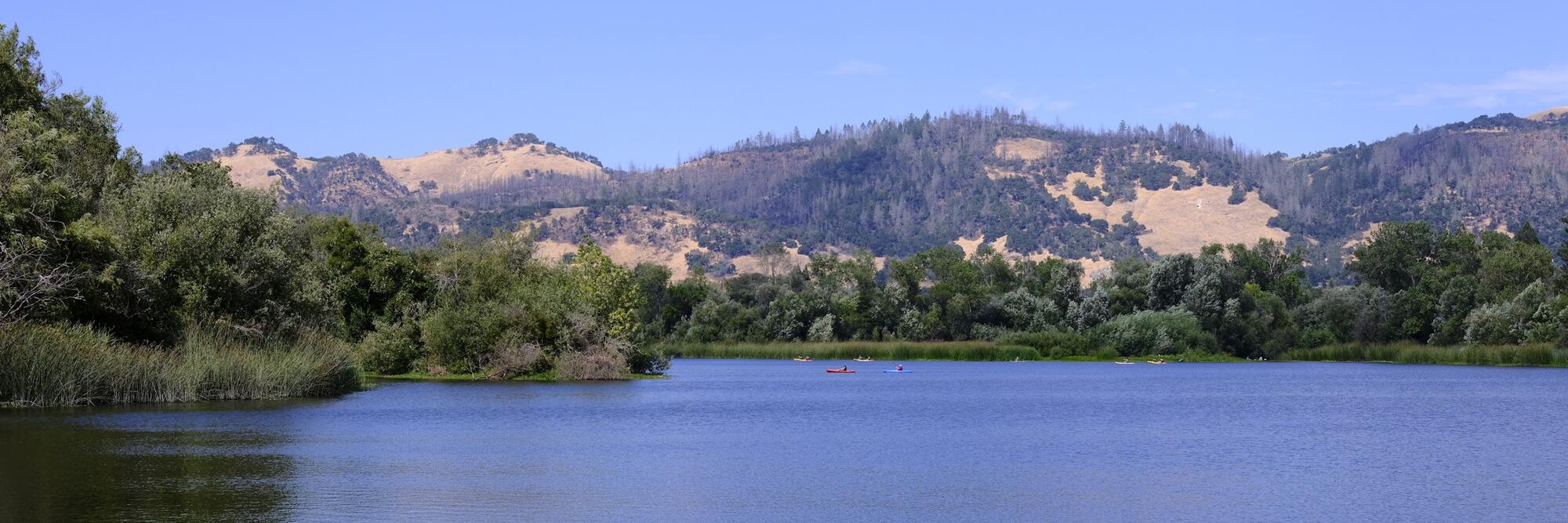
The options for accommodation in Santa Rosa are as varied as the city itself. There are walkable historic streets around downtown, the established suburbs of the east side, hillside pockets on larger lots, and whole neighbourhoods that were rebuilt after the 2017 wildfires. Newcomers from across the Bay Area move here for more room and a gentler pace than they would get in San Francisco, about 55 miles (90km) to the south.
Areas and suburbs in Santa Rosa
Highway 101 is the main north-to-south road, and Highway 12 is the main east-to-west one. Between them, the areas and suburbs in Santa Rosa are grouped into four rough quadrants. West of the freeway is the walkable, older core of the city, where Downtown is located.
Santa Rosa is more suburban to the east. Bennett Valley, southeast of downtown between Taylor Mountain and Trione-Annadel State Park, is a long-established favourite for its parks, golf, and trail access, and Rincon Valley to the northeast has the same quick reach to the outdoors and is a favourite among families.
Fountaingrove, in the northeastern hills, is the city’s premier address, where median house costs rise above the 1 million USD mark. The views are stunning, though. Skyhawk also has panoramic hillside views and is a slightly cheaper option, with the median house price sitting a little below rather than above 1 million USD.
The hillside and edge-of-city neighbourhoods, Fountaingrove and Mark West among them, have the highest fire hazard ratings, and home insurance there is harder to arrange and considerably dearer than on the valley floor. Some owners in the highest-risk zones can only get cover through the California FAIR Plan, the state’s insurer of last resort. Check the CAL FIRE hazard-severity maps for any address you are serious about, and line up an insurance quote early.
Best Places to Live in Santa Rosa
Types of accommodation in Santa Rosa
The most common type of accommodation in Santa Rosa by a wide margin is the detached single-family house with its own yard – close to three in five homes here are of that kind.
Beyond the standalone house, townhouses and flats are the next most common form, and condominiums are close behind. About a quarter of all homes are in multi-unit buildings, and that is where most renters concentrate their search. The east side is almost all detached houses, while the south and southwest have the widest choice, including flats, townhomes and older single-family houses.
Finding accommodation in Santa Rosa

For most house hunters, finding accommodation in Santa Rosa begins online. The big national listing sites have most of what is available to rent.
Word of mouth still counts for a lot in Santa Rosa, though. Owners and residents often post rentals in community and neighbourhood groups on social media before those places reach the big portals, especially rooms and in-law units that are let directly by owners.
If you would rather someone else did the legwork, a letting agent or property manager can line up viewings for you. In California, the landlord almost always pays the agent’s fee, so using one rarely costs a renter anything extra.
Some new arrivals will be lucky enough to have a relocation company working on their behalf, which can draw up a shortlist of properties to view based on needs and wants.
Useful links
Renting accommodation in Santa Rosa

Making an application
Expect to fill in a written application and to agree to a credit and background check. A landlord may charge a screening fee to cover the cost of running those checks, but only up to a cap that the state sets each year. They must refund any part of the fee they do not spend. If a landlord runs a credit report, you're owed a copy within seven days.
Landlords are required to review completed applications in the order they arrive and offer the home to the first applicant who meets their written criteria. By law, they cannot base this decision on race, religion, sex, national origin, disability, or family status.
Leases
Most leases here are for a fixed term of a year, although month-to-month agreements are common, too. A fixed-term lease ends on its final date, and neither party has to give notice unless the lease requires it. If you stay on afterwards with the landlord’s agreement but do not sign a new lease, the tenancy becomes month-to-month on the same terms.
Note that once you've lived somewhere for 12 months or more, the landlord needs a legally recognised reason (just cause) to end the tenancy at all.
Deposits
The security deposit on most rentals is legally capped at one month’s rent, furnished or not, and any pet deposit counts towards that limit. 'Small' landlords (broadly, an individual or family who owns no more than two rental properties totalling four units or fewer) may ask for up to two months.
After you move out, the landlord has 21 days to return the deposit or to send you an itemised list of deductions. The landlord cannot bill you for cleaning or carpet cleaning unless the unit was professionally cleaned before you moved in. A landlord who wants to make deductions has to photograph the property’s condition both before you move in and after you leave.
Terminating the lease
To end a month-to-month tenancy, either party must give written notice. As a tenant, you give 30 days’ notice, regardless of how long you have lived there. A landlord gives 30 days if you have been in the home under a year, or 60 days once you pass the one-year mark.
A landlord must always give you at least 24 hours’ written notice before entering the home, except in a genuine emergency.
Renting Accommodation in the USA
Useful links
Utilities in Santa Rosa

Setting up utilities in Santa Rosa is quite straightforward. You’ll deal with a different provider for electricity, gas, water, and refuse collection, but signing up for each takes little more than a phone call or an online form.
Electricity and gas
Pacific Gas and Electric (PG&E) handles gas as well as the delivery and billing of your electricity, so a PG&E account is the starting point for both.
In Sonoma County, the default electricity supplier is Sonoma Clean Power (SCP), a local public agency, and you are automatically signed up with them when you open a PG&E account. You can opt out and have your generation from PG&E instead if you would prefer. SCP’s standard CleanStart service is mostly renewable, and its premium EverGreen option is 100 percent renewable, locally generated power for a little more. Either way, you still get the power through PG&E and pay your bill to them.
Water
City department Santa Rosa Water supplies both water and sewer service, and you set up an account with them directly. You need to give at least one business day’s notice to start or stop service. About 95 percent of the supply is Russian River water. The rest is from the city’s own groundwater wells and a little recycled water. The river water is drawn from collector wells around 100 feet (30m) below the riverbed, where layers of sand and gravel act as a natural filter, and it is well regarded for its quality.
Bins and recycling
Recology Sonoma Marin handles all kerbside collection of rubbish, recycling, and compost. Collection is weekly, and there are three colour-coded carts: grey for rubbish, blue for recycling, and green for organic and garden waste.
You can pick from four sizes of grey cart, and the smaller the one you choose, the lower your bill will be. The blue and green carts are free, and both are the largest size as standard. Carts should go out the night before and come back in within a day of the pickup.