

Getting around in Washington, DC, is a breeze. The city is home to one of the USA’s most active populations, with many of the capital’s residents choosing to walk or cycle to work if they live close to the city centre. The city does, however, have a solid public transport network to assist commuters, which includes various train and bus services.
New arrivals will find that most places in the city centre are located close to one another, and sometimes walking, rather than driving or taking public transport, can actually be the quickest way to get somewhere.
Public transport in Washington, DC
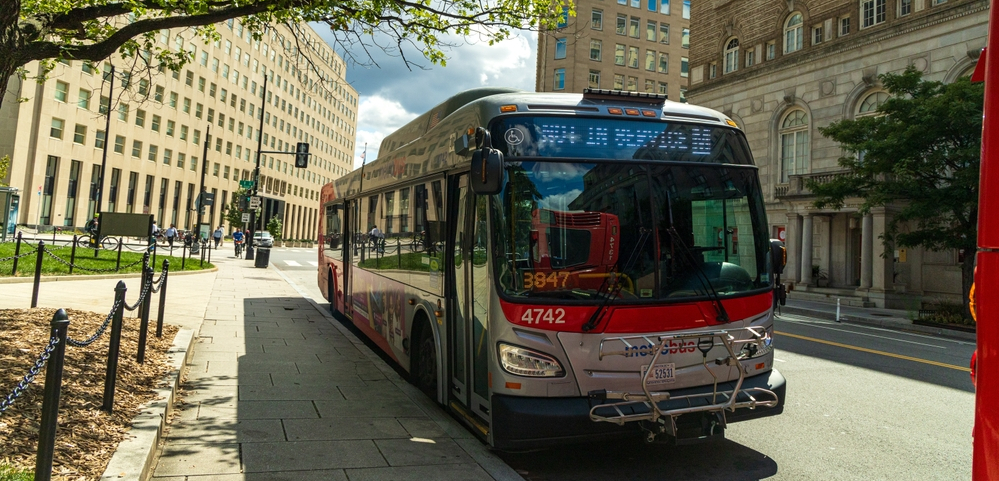
Washington, DC’s public transport network consists of train and bus services. This network is operated on an integrated ticketing system, which covers all modes of transport.
SmarTrip card
If you intend to travel in and around DC via public transport, you’ll need a SmarTrip card. They can be purchased online or at a station. The card is a unified payment method and can be used on the Metrorail in DC, Virginia, and Maryland, as well as on DC’s Metrobus. SmarTrip cards can be topped up online, at any metro station and at selected stores in the city.
Metrorail
The Metrorail lies at the heart of Washington, DC’s public transport network. This system consists of six colour-coded lines, which run primarily underground to serve downtown, and overground to some of Washington’s surrounding suburbs. Nearly 100 stations make up the network.
From Monday to Friday, the Metrorail begins operating at 5am, while Saturdays and Sundays see services beginning from 6am. On Sunday through Thursday, services end at midnight, with Friday and Saturday services ending at 2am. If you miss the last train, the bus is an ideal alternative, as it has select routes that run 24/7.
While DC’s metro is clean, safe and user-friendly, commuters sometimes complain about the irregularity of services caused primarily by track maintenance and periodic breakdowns.
Metrobus
DC’s Metrobus service consists of hundreds of routes that cover the greater DC area. Buses operate daily, beginning in the early morning until 11pm or 1am on weekends, while specific late-night buses operate through the night on certain routes.
Useful links
Taxis in Washington, DC
There are a considerable number of cab companies to choose from in Washington, DC, and taxis can be paid for with either cash or card. Taxis use a metered fare system and can be hailed on the street or ordered over the phone. Drivers are required to take passengers anywhere within the Metropolitan area of DC, but most drivers are reluctant to travel to Maryland and Virginia.
Ride-hailing services like Uber and Lyft also operate in Washington, DC. These services can be cheaper than using a regular taxi, and new arrivals will have the advantage of knowing the fare beforehand.
Useful links
Driving in Washington, DC

In most cases, DC residents opt to use public transport or cycle to work rather than driving, especially in the city centre. Those who do decide to drive in Washington, DC, will notice that parking is expensive and hard to find. Traffic is also routinely congested, and navigation is made complex by the one-way roads dotting the city centre.
Driver’s licences
Visitors can drive on their valid out-of-state driver’s licence for 30 to 60 days, but once they’ve established residency in DC, they’re typically required to convert to a DC driver’s licence. The city has reciprocity agreements with many countries, meaning that expats from those countries can easily exchange their foreign licence for a DC licence without taking the road test, provided they meet other requirements. Be sure to check with the Washington, DC, DMV to see whether your home country has such an agreement.
Those from non-English speaking countries without a reciprocal agreement will likely need to pass the DC driving tests to obtain a driver’s licence.
If your non-US driver’s licence is in a language other than English, it’s a good practice to also carry an International Driving Permit (IDP) alongside the original licence when driving. The IDP provides a translation of the licence details. It’s worth noting that while an IDP is recognised and can help translate non-English licences, it isn’t a replacement for a valid driver’s licence.
Useful links
Cycling in Washington, DC
The residents of DC love to cycle, and new arrivals will find that cycling is a great way to get around the city.
The city has an excellent bike-sharing system. The Capital Bikeshare network consists of more than 6,100 bicycles that can be picked up and dropped off at any one of the 600 docking stations across the city.
The government has taken steps to make Washington, DC, more cyclist-friendly by increasing the number of dedicated cycle lanes as well as the amount of safe bicycle storage facilities. Bicycles can also be brought onto both the Metrorail and Metrobuses in DC at no extra cost.