
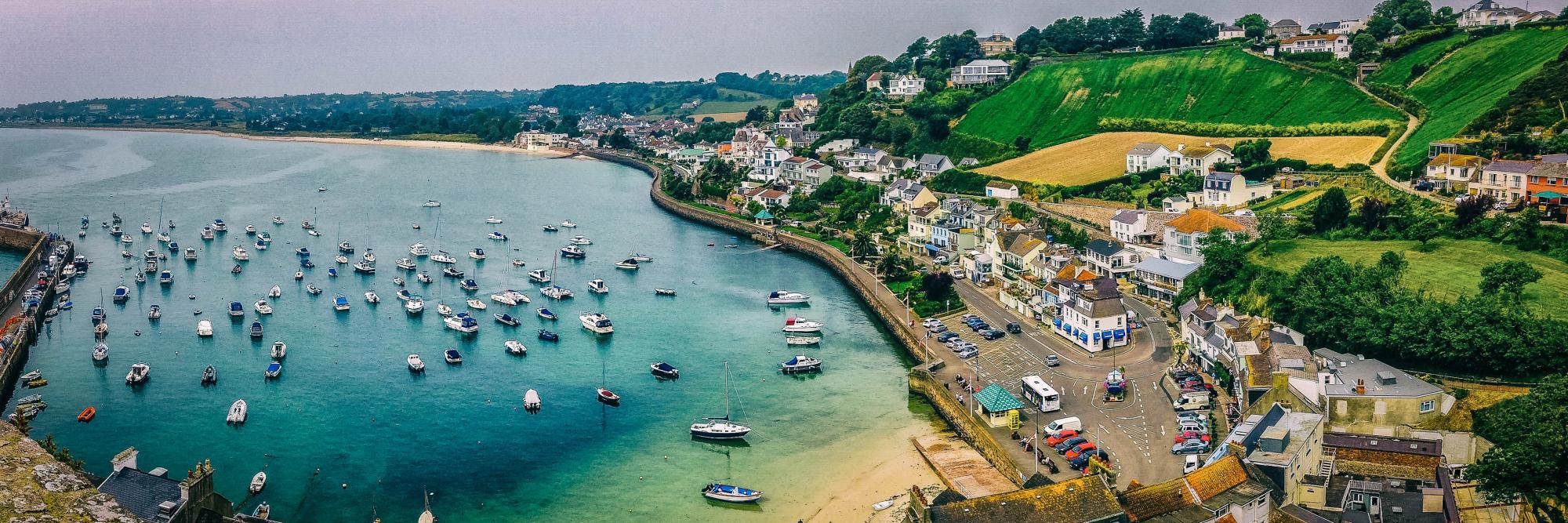
Expats moving to the Channel Islands will be settling on an archipelago in the English Channel, just off the coast of Normandy, France. The two largest islands are Jersey and Guernsey, and the smaller inhabited islands include Alderney and Sark.
Living in the Channel Islands as an expat
The Channel Islands have been Crown Dependencies of the British monarch since the Norman Conquest of 1066, but technically, they aren't part of the United Kingdom. The islands are governed as two separate bailiwicks: the Bailiwick of Jersey and the Bailiwick of Guernsey.
Each bailiwick sets its own policies for central issues such as healthcare, immigration, homeownership, schooling and more. Britain is responsible only for the islands' defence and foreign affairs. In terms of culture, cuisine and history, the Channel Islands have also been shaped by nearby France.
The Channel Islands are well known as a low-tax jurisdiction, and while the islands are not entirely tax free, taxes are lower than in many other countries. Financial services are the backbone of both Jersey and Guernsey's economies, and tourism is another major industry. Expats with experience and qualifications in these fields, and who can demonstrate they can fill a skills gap, will more easily find lucrative employment on the islands.
Accommodation isn't easy to come by in the Channel Islands, as residential qualifications are required to rent or buy many of the properties. These are usually granted only to expats who will fill skills gaps in local markets or bring significant revenue to the islands. Space is at a premium on the islands, which means demand for housing is incredibly high.
Working in the Channel Islands
Accommodation in the Channel Islands
Culture in the Channel Islands
Cost of living in the Channel Islands
The cost of living in the Channel Islands is far from cheap, especially when it comes to accommodation, furniture and groceries. Both Jersey and Guernsey are more expensive than the UK mainland, with Jersey being the pricier of the two. Expats who manage to secure a job in the Channel Islands will find that salaries are fairly high to compensate for the high cost of living.
Cost of Living in the Channel Islands
Taxes and Money in the Channel Islands
Expat families and children in the Channel Islands
The Channel Islands are a wonderful place to raise a family. Education is high quality and inexpensive, locals are friendly, and a beach is never more than a stone's throw away. There's also plenty of opportunity for family holidays to France or the UK, both of which are just a ferry ride away.
Healthcare in the Channel Islands
Schools and Education in the Channel Islands
Climate in the Channel Islands
New arrivals can expect a pleasant climate thanks to the more southerly location of the islands in comparison to the UK. Jersey is one of the warmest locations in the British Isles. Even in the colder winter months, snow and ice are rare.
Climate in the Channel Islands
There's no doubt that moving to Jersey or Guernsey can be challenging, particularly when it comes to red tape. That said, expats who can secure employment and housing report an outstanding quality of life, and often stay far longer than intended.
Fast facts
Official name: Bailiwick of Jersey and Bailiwick of Guernsey (collectively the Channel Islands)
Population: Around 170,000
Capital cities: Saint Helier (Jersey) and Saint Peter Port (Guernsey)
Other towns: Saint Anne (Alderney), with smaller settlements on Sark and Herm
Neighbouring countries: The English Channel completely surrounds the Channel Islands. The closest countries are England to the north and France to the south and east.
Geography: There are seven permanently inhabited islands, of which Jersey, Guernsey, Alderney and Sark are the most populous. There are also several uninhabited islets. Jersey is the largest at around 46 square miles (119 sq km), while Guernsey covers roughly 25 square miles (65 sq km).
Political system: The islands are Crown Dependencies of the British monarch, each with its own legal system, administrative bodies and fiscal policies. Defence and international affairs are handled by the UK.
Major religion: Christianity
Main languages: English. French has historical significance, and some Norman-French dialects survive, although their use has declined.
Money: The British Pound Sterling (GBP) is the primary currency. Both Guernsey (GGP) and Jersey (JEP) issue their own local versions of the pound at a fixed one-to-one parity with sterling. UK currency is accepted throughout the islands, but Channel Islands currency cannot be used elsewhere. The islands are home to a well-established banking sector, and expats can open local accounts.
Tipping: 10 to 15 percent of the bill in restaurants, hotels and taxis is the norm if a service charge has not already been added.
Time: GMT (GMT+1 from the last Sunday in March to the last Sunday in October)
Electricity: 230V, 50Hz. Three-pin rectangular plugs (Type G) are standard, the same as in the UK.
Internet domain: .je (Jersey), .gg (Guernsey)
International dialling code: +44
Emergency contacts: 999 or 112
Transport and driving: Driving is on the left-hand side. Jersey and Guernsey both have efficient bus services, and the islands are small enough that many residents get by without a car. Ferry services connect the islands to the UK and France. Interisland ferries and small airlines also link the archipelago.