
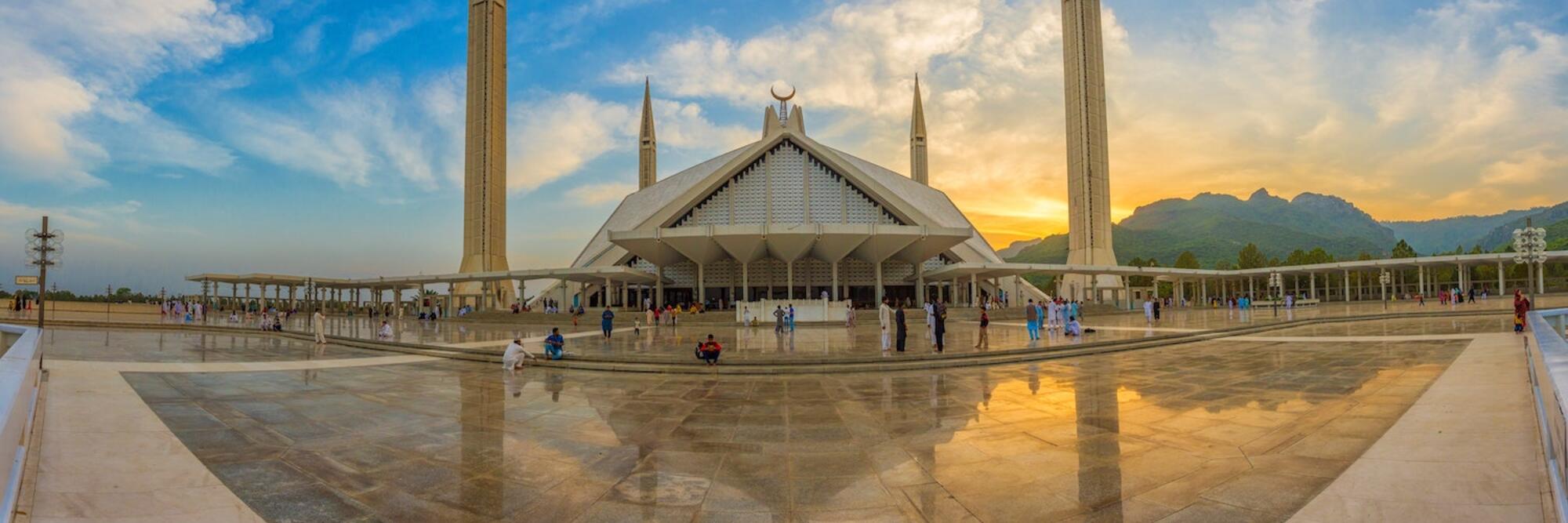
Moving to Pakistan puts you in a country known for its devotion to cricket and its snow-capped northern peaks. Pakistan is the fifth-most populous country in the world, and it has made considerable economic progress since its independence in 1947. Its official name is the Islamic Republic of Pakistan, and the word itself means ‘Land of the Pure’. The hardships of daily life are real, but an open mind sets you up for a memorable cultural experience.
To the south, Pakistan meets the Arabian Sea and the Gulf of Oman. On land, it borders India to the east, Afghanistan to the west, Iran to the southwest, and China to the northeast. Centuries of kingdoms and empires have left their mark on the country, and it has been left with cultural influences from each of them.
Living in Pakistan as an expat
Living in Pakistan as an expat means joining a semi-industrialised economy that still ranks among the world’s largest producers of natural commodities. Political instability and other constraints have slowed its growth, so the economy is still developing. Exports carry much of it, and you may find work in sectors such as manufacturing, technology, telecommunications, and tourism. If you are coming to work, you will need a work visa sponsored by your employer, submitted through Pakistan’s online visa system.
The public transport system in Pakistan tends to be overcrowded, and bus drivers often take risks behind the wheel. Hire a car, ideally with a driver; it is the most comfortable way to get around.
Safety is a serious concern, and you should treat it as one. Pakistan has a long history of terrorist attacks, and several Western governments advise against travel to certain regions altogether. The risk is heavily concentrated in Balochistan, Khyber Pakhtunkhwa, the border regions with Afghanistan and India, and the Line of Control in Kashmir. The major cities have seen far fewer incidents, but vigilance is still needed around markets, malls, public gatherings, and places of worship.
Check your home country’s travel advisories before and during your stay, avoid large crowds, register with your embassy when you arrive, and keep an eye on the local news. The northern valleys around Hunza and Skardu in Gilgit Baltistan are the exception: they have attracted record numbers of visitors and are considered much safer.
Working in Pakistan
Public Transport and Driving in Pakistan
Safety in Pakistan
Cost of living in Pakistan
The cost of living in Pakistan is low, especially compared to the better-known expat destinations. Accommodation will likely be your biggest monthly outgoing, although affordable options are available if you know where to look.
If you are bringing children, school fees are the next biggest cost. Most expat families choose international schools, which are often expensive. Eating out, groceries, transport, and everyday essentials all come cheap.
Families and children in Pakistan
Families and children in Pakistan are entitled to free, compulsory public schooling, but the system struggles with low literacy and a wide gender gap. More than a third of adults cannot read, and far fewer girls than boys complete their schooling. State school standards are generally low, so most expat parents choose the international schools in Islamabad and other cities where foreigners settle.
There is plenty to do with your children. Pakistan has a deep stock of historical and cultural sites that double as a day out and a history lesson. You can just as easily spend an afternoon at the markets, the malls, a museum, or one of the country’s grand mosques. Hikers are spoilt for choice: the north holds some of the planet’s highest peaks, including K2 in the Karakoram, and the trails come with views to match. One thing first-time visitors rarely expect is the welcome; Pakistanis are famously hospitable, and foreigners are often treated as honoured guests.
Pakistan has both public and private healthcare facilities. The public system is often poor, so most expats use private care instead. Take out a health insurance plan that includes repatriation coverage; it is one expense you should not skip.
Education and Schools in Pakistan
Healthcare in Pakistan
Climate in Pakistan
The climate in Pakistan is continental, and temperatures swing to extremes. For most of the country and most of the year, though, the watchword is heat. Seasons start and end at different times around the country, but most years run through a cool, dry winter, a hot spring, a summer monsoon, and a milder autumn.
One seasonal hazard worth planning for is smog. From late autumn through winter, cool, still air traps pollution over the plains of Punjab, and Lahore in particular routinely ranks among the most polluted cities on earth. If you have young children or a respiratory condition, the winter air in big cities is something to consider.
The country faces real challenges, among them political instability, corruption, poverty, and illiteracy. Successive governments have rolled out plans to tackle these problems, and the economy continues to show promise.
Tourism has climbed steadily as more travellers cotton on to the country’s appeal. It is not the most straightforward place to set up home, but if you come ready to take the rough with the smooth, the rewards are well worth it.
Fast facts
Official name: Islamic Republic of Pakistan
Population: Around 255 million
Capital city: Islamabad
Largest city: Karachi
Other cities: Lahore, Faisalabad, Rawalpindi, Peshawar
Neighbouring countries: Pakistan shares land borders with India to the east, China to the northeast, Afghanistan to the west, and Iran to the southwest. Its southern coastline runs along the Arabian Sea.
Geography: Pakistan is divided into three broad regions: the northern highlands, the Indus River plain through the centre, and the Balochistan Plateau in the southwest. Earthquakes are a risk in parts of the country, and heavy monsoon rains bring serious flooding most years.
Political system: Federal parliamentary constitutional republic
Major religion: Islam
Main languages: Urdu (national) and English (official) are both widely used in government and business. Punjabi, Pashto, Sindhi, and Saraiki are among the many regional languages spoken at home.
Money: The Pakistani Rupee (PKR), written as 'Rs'. Foreign residents can open a local bank account once they have a valid visa and the usual paperwork (passport, proof of address, proof of income, and a reference from their employer); most major banks will serve expats. Pakistan is largely a cash-based society. ATMs are common in cities and larger towns, becoming scarcer in rural areas.
Tipping: Tipping is customary but not obligatory. Around 10 percent is normal in restaurants when a service charge has not already been added, and small tips for porters, drivers, petrol attendants, and household staff are appreciated.
Time: GMT+5
Electricity: 230V, 50Hz. Sockets generally take two or three-pin round plugs (types C and D); British-style three-pin plugs (type G) can also be found.
Internet domain: .pk
International dialling code: +92
Emergency contacts: 15 (police), 115 (ambulance), 16 (fire brigade)
Transport and driving: Cars drive on the left-hand side of the road. Public transport in the larger cities has improved thanks to metro, bus, and rapid transit lines, but services are crowded, and many expats prefer to hire a car and driver.