

- Download our Moving to Thailand Guide (PDF)
Managing banking, money, and taxes in Thailand is fairly easy. Banks in Thailand are modern, reliable and easily accessible, and English-speaking personnel can be found in most main branches.
Opening a bank account in Thailand requires long-term residency documentation. The process becomes straightforward with the right visa. ATMs are widely available, and expats who stay in the country for a longer time can apply for local credit.
Most expats will be relieved to learn that Thailand has signed double-taxation avoidance agreements with several governments. It should also be relatively simple for expats who retire in Thailand to access their pensions.
Money in Thailand
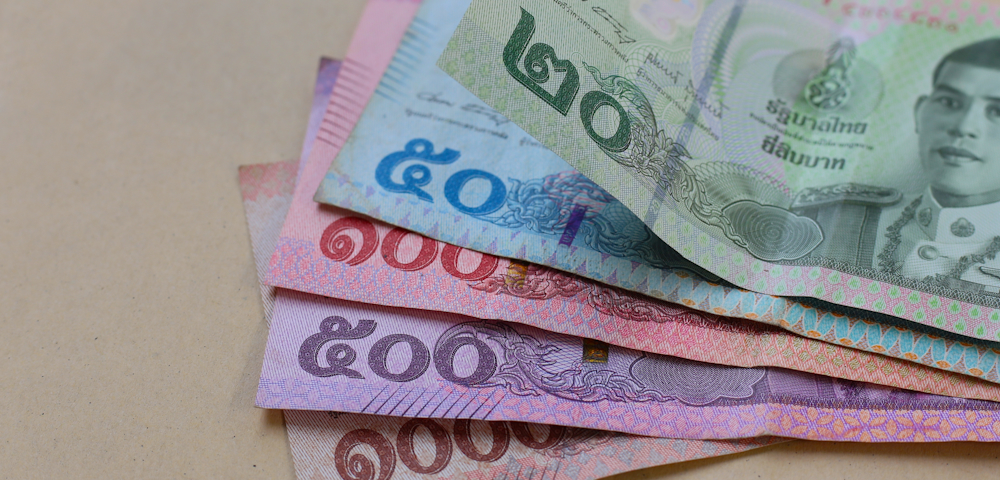
The official currency in Thailand is the Baht (THB), which is issued by the Bank of Thailand. One baht is subdivided into 100 satangs.
- Notes: THB 20, THB 50, THB 100, THB 500 and THB 1,000
- Coins: THB 1, THB 2, THB 5 and THB 10 (commonly used), plus 25 satang and 50 satang (less common, as many vendors prefer to round to the nearest baht)
Digital payments have taken over a lot of transactions in Thailand, with QR code transactions and mobile banking apps like PromptPay a new standard in urban commerce. Cash is still important for street vendors and rural areas, but you’ll find QR payment options at everything from 7-Elevens to street food stalls.
Banking in Thailand
Major local banks include Bangkok Bank, Kasikornbank, Siam Commercial Bank, and Krungsri. If you need international banking, institutions like UOB and HSBC also operate in Thailand.
Recent changes mean expats who want to open a local bank account in Thailand now need long-term residency documents. Most banks accept work permits, student visas, retirement visas, or other non-immigrant visas. They won’t likely accept a tourist visa, although some expats report success applying at a bank branch located in one of the more ‘expat areas’. Usually, you’ll need your passport, long-term visa, proof of address (like a certificate of residence), and a Thai phone number.
Sometimes documentation that needs to be signed is written in Thai, but you can request a translated copy in English. Expats should note that, in some cases, the type of bank account available to them will depend on the type of visa they hold.
Credit cards and ATMs
Expats can get a credit card from a Thai bank, but this can be a surprisingly difficult task. Requirements vary between banks, but most, if not all, require a work permit, ideally one you’ve held for a significant length of time. There is also a required minimum income, and you’ll need bank statements for a specified period. The longer you’ve been a client of a Thai bank, the better your chances are of successfully applying for a credit card.
All major banks provide widespread ATM access throughout Thailand. Withdrawals using foreign cards typically incur a fee. Account holders with Thai banks generally have fee-free access at their own bank’s ATMs, although transactions at other banks’ machines incur nominal charges.
Taxes in Thailand
Expat tax laws in Thailand differ slightly for residents and non-residents.
- Expats who ordinarily live in Thailand less than 180 days a year are classified as non-residents for tax purposes. They can therefore only be taxed on income derived from within Thailand. Income from outside of Thailand is not taxed.
- Tax residents are taxed on both Thai-sourced income and foreign income remitted to Thailand. There were some significant changes in 2024 which expanded the scope of taxable foreign income for residents.
Thailand has signed tax treaties with several countries worldwide to avoid double taxation for many expats.
Income tax rates in Thailand are progressive, ranging from zero to 35 percent. Employers and employees both contribute to Thailand’s social security system to help cover public healthcare, unemployment, and other social protections, and employee contributions are capped at a modest percentage of monthly salary.
A specialist expat tax adviser can help you understand compliance requirements and maximise available deductions and treaty benefits. Tax forms typically appear in Thai, making professional guidance particularly worthwhile.