

- Download our Moving to Thailand Guide (PDF)
The local culture in Thailand is known for its warmly welcoming people and the pride they take in their traditions. Expats moving to Thailand can expect some degree of culture shock, yet most find that local hospitality eases the transition considerably.
Meeting and greeting in Thailand
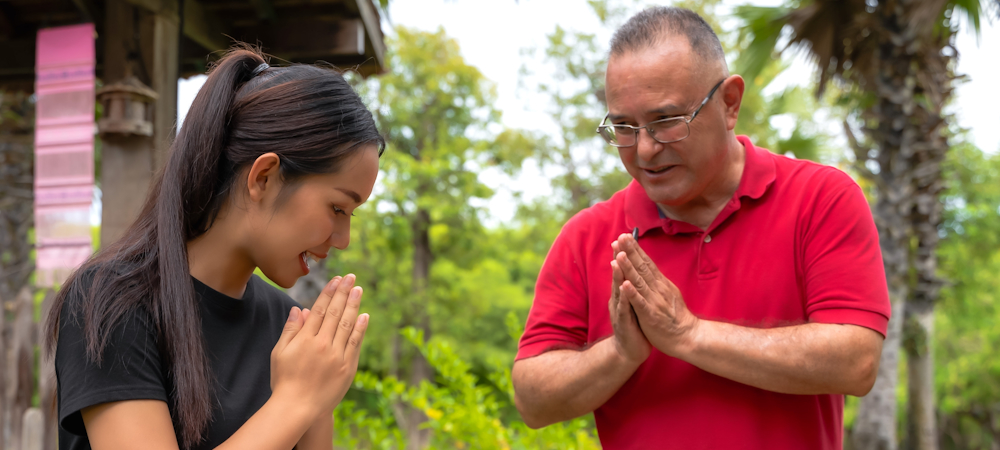
In Thai culture, greeting someone is an act of great significance. The manner of greeting is determined according to the social standing of both people. Making the wrong move could cause a Thai person to lose face – this is considered a bad look for both parties and should be avoided at all costs. That said, when used correctly, greetings are an opportunity to show deep respect for the Thai people.
For a traditional Thai greeting, palms are placed together in a prayer-like gesture somewhere between the chest and the forehead. They are held close to the body whilst a slight bow is made. The higher the hands and the lower the bow, the more respect is shown. This is called a wai.
The proper etiquette is for the subordinate party to offer a wai first, with the senior person then returning the wai. Thai locals won’t expect a foreigner to initiate a wai, but if offered one, not returning it would be an insult.
Foreigners aren’t expected to initiate a wai with service staff. A smile and nod work just fine, although returning a wai when offered is always polite.
Dress in Thailand
Outward appearances are important to Thai people. Here, the old saying ‘dress for success’ holds true. Thai locals appreciate foreigners who strive to maintain a professional, reserved appearance. T-shirts and shorts are acceptable for just about anywhere, but pants and skirts should be modest in length. Women should keep their chests and shoulders covered.
Dress codes for office jobs in Thailand vary by industry. Banking and law maintain formal standards in which men wear dress pants, collared shirts, and ties. Bangkok’s tech and startup scene has shifted towards smart casual, but looking polished still matters. In the humid climate, breathable fabrics are your best friend.
In beach towns like Phuket, Hua Hin and Krabi, Thai locals are more accustomed to foreigners wearing bikinis and swimwear at the beach, but when going for lunch or a stroll around town, expats should cover up.
Language barrier in Thailand
Thai is a tonal language with five different tones. The tone of a word is used to distinguish its meaning. If an expat correctly pronounces a word but uses the wrong vocal tone, it may have an entirely different meaning from what they intended to say. The upside is that Thais are extremely forgiving when foreigners try to speak their language, and are usually happy to help with corrections.
English proficiency in Thailand ranks among the lowest in Asia. Outside tourist zones and Bangkok’s international business districts, English speakers are scarce. Translation apps help bridge the gap, yet learning basic Thai phrases will get you further than you might expect.
Religion in Thailand

Most of the population in Thailand is Buddhist. Buddhism plays an important role in the cultural background and outlook of the local population. The country is also full of beautiful Buddhist temples known as wats.
Other religions are practised in Thailand, though, and everyone’s right to the faith of their choice is protected.
Women in Thailand
Women in Thailand occupy a strong position in the business world. Roughly one-third of senior management positions are held by women, among the highest rates globally. Thai women lead the world in holding CFO positions.
Most female expats report that they find professional settings safe and respectful, although they generally find international companies offer more advancement opportunities than traditional Thai-owned firms. Formal work-life balance policies are rare.
Gender Equality and Women in Leadership in Thailand
LGBTQ+ in Thailand
In January 2025, Thailand became the first Southeast Asian country to legalise same-sex marriage. The Equal Marriage Law grants same-sex couples rights to adoption, inheritance, medical decisions and tax benefits on par with heterosexual couples. Thailand joins Taiwan and Nepal as the only Asian nations recognising marriage equality. What was once tolerance has become legal equality, a significant shift for the region.
Bangkok and Pattaya are particularly accepting. LGBTQ+ individuals are well integrated into professional life in these cities. Workplace culture is mostly inclusive, although rural and conservative areas are a little more conservative.
LGBTQ+, Diversity and Inclusion in Thailand
Time in Thailand

The national anthem plays twice daily at 8am and 6pm in public spaces. Everyone stops and stands still whilst it plays, even mid-stride. This includes foreigners.
Thai business culture prioritises relationships before schedules. Meetings typically open with small talk, so don’t rush into business.
Cultural dos and don’ts in Thailand
- Do show great respect to the Thai royal family. The local population highly reveres them.
- Don’t criticise or joke about the royal family, including on social media. Thailand’s lèse-majesté laws carry sentences of three to fifteen years per offence. Foreigners can face prosecution. The laws apply to any perceived insult to the monarchy. Expats should avoid all discussions about Thai royalty.
- Do take the Thai national anthem seriously. It is broadcast twice daily over television and radio – when the flag is raised every day at 8am, and when it’s lowered just before sunset. When the anthem is played, everyone must stop what they are doing and stand at attention in respect.
- Don’t ever touch the head of a Thai person or pass any objects over someone’s head. The head is the highest part of the body and is considered sacred in Thailand. It must be treated with the utmost respect.
- Don’t use your feet for anything other than standing or walking. It is unacceptable to put your feet on a table or desk, and expats should avoid pointing them at people. It is also considered impolite to touch your feet in public.
- Do keep your cool. The Thai phrase jai yen, meaning ‘cool heart’, is a way of life. It refers to the ability to stay composed, calm and patient in tense situations. Thai people go to great lengths to avoid confrontation and remain diplomatic.