
- Download our Moving to Bangkok Guide (PDF)
Expats won’t have any trouble getting around in Bangkok, as transport options are endless. Most expats tend to favour public transport, particularly the city’s BTS Skytrain, and taxis are also popular. Travelling by foot is not ideal in Bangkok, while travelling by car tends to be equal parts dangerous and frustrating. That said, driving may be essential for those living in areas not accessible by public transport.
Public transport in Bangkok
Metro
Getting around in Bangkok via the Metropolitan Rapid Transit (MRT), known as the metro, offers expats a reliable option.
The network now has four operational lines: the Blue Line (a mostly underground loop around central Bangkok), the Purple Line (serving the northwest), and the Yellow and Pink monorail lines (serving eastern and northern suburbs respectively). The Orange Line is under construction. All lines operate from 6am to midnight daily.
Trains
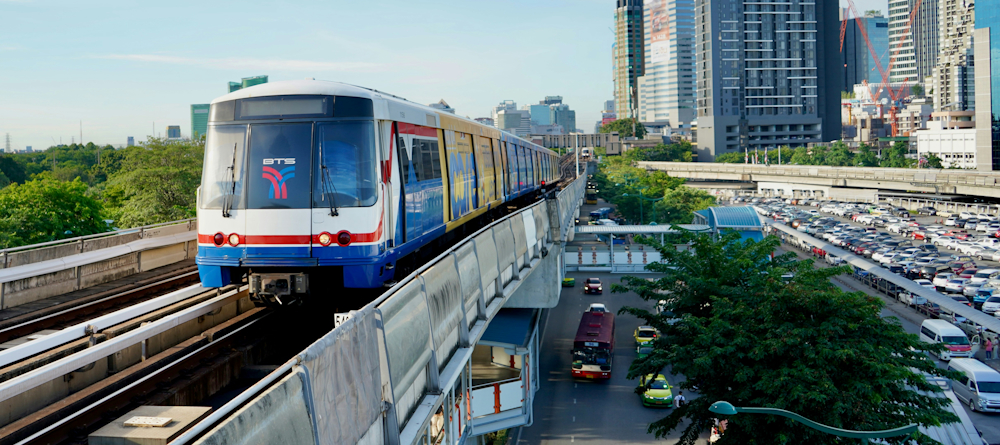
A popular mode of transport among expats in Bangkok is the BTS Skytrain. This elevated train system threads the main business, entertainment and hospitality districts of Silom and Sukhumvit. It is a reliable, clean and safe way to travel in Bangkok. Expect long waiting times and overcrowding during peak morning and afternoon hours.
Buses
There is an extensive bus system in Bangkok. Although this is a cheap way to travel, it is often uncomfortable and can be slow due to heavy traffic. For this reason, it is not generally a popular option with expats, though buses can be useful for long-distance, rural, and intercity travel. A wide variety of private services operate routes to different parts of Thailand.
Dark blue electric buses, operated by Thai Smile Bus, have been rolled out across many routes since 2022 and are all air-conditioned.
If your bus isn’t dark blue, there are a few things to look out for under the legacy colour-coding system. Traditional red buses are more spacious; green buses lack air-conditioning but are more affordable; and cream, blue, and white buses provide spacious air-conditioned travel. Buses typically run from 5am to 11pm, although some routes now offer 24-hour service.
Useful links
- BTS Skytrain’s website and the MRT’s website have more on routes, specials, and ticket purchases.
Taxis in Bangkok
Taxis provide the most reliable, convenient, cost-effective and efficient way of getting around in Bangkok. These vehicles are never in short supply and are available around the clock. Expats can simply flag one down, hop in and prepare to pay the fare.
Taxis are usually fitted with a meter that charges a set rate per kilometre – by law, the meter should be turned on, but some drivers deliberately leave them off to charge the passenger a higher price. If the driver refuses to use the meter even after you request it, the best response is to promptly exit the taxi and find another one.
Most taxi drivers have limited English skills. Expats living in Bangkok will quickly learn that it is best to have the address of their destination written down in Thai, or they may experience an unsolicited tour of the city.
The language barrier, paired with the possibility of being overcharged, is best circumvented by using ride-hailing apps. Grab is still the most widely used platform, although Bolt often offers lower fares, and inDrive lets passengers negotiate prices directly with drivers. All three apps provide English interfaces and transparent pricing.
Tuk-tuks
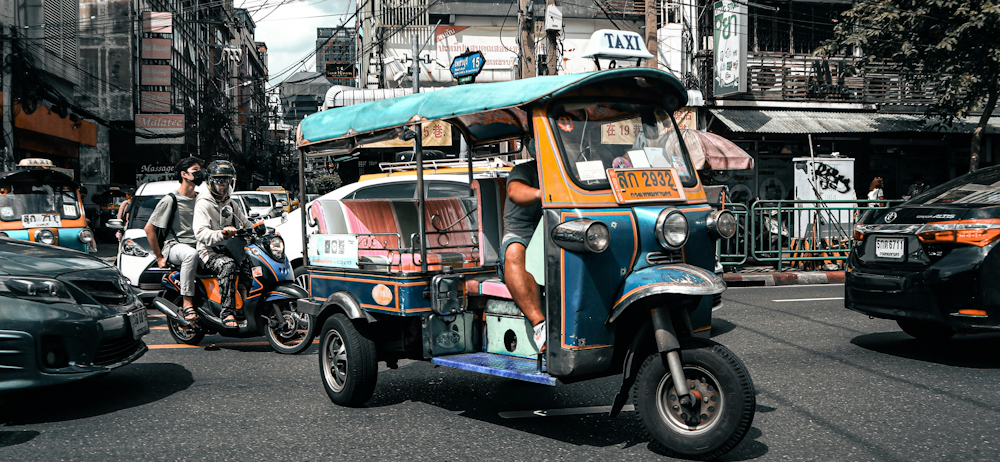
Expats in Thailand will quickly become familiar with tuk-tuks, open-air three-wheeled carriages attached to motorbikes. The city is served by thousands of them, and while they are popular with tourists, they are also useful for expats and locals. Tuk-tuks are a speedy way to get around, as their size allows them to weave in and out of traffic.
Songthaews
Also known as ‘red buses’ or ‘red trucks’, songthaews are another popular choice of transport in Thailand. These passenger vehicles are adapted from pickup trucks and serve as shared taxis. Songthaews are used both within towns and cities, as well as for longer routes between towns and villages.
Useful links
Driving in Bangkok
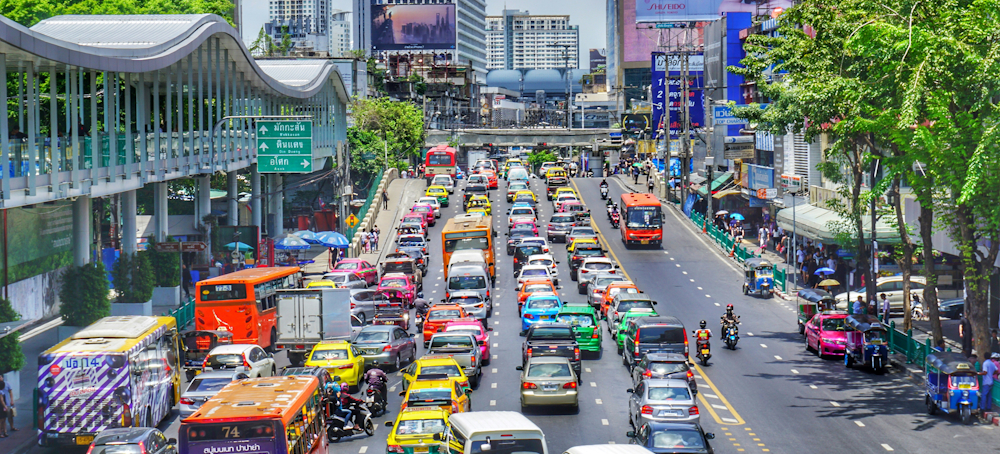
Many expats avoid driving in Bangkok due to the city's heavy traffic and dangerous roads. Expats who do intend to drive can buy a new car in Thailand or import theirs from home, but both options are expensive.
It’s not uncommon for expats to hire experienced Thai drivers rather than braving the roads themselves. This is an ideal solution, and some employers may agree to include it as part of the relocation package.
Driver’s licences
Foreign driving licences paired with an International Driving Permit (IDP) are acceptable for tourists, typically for up to 90 days depending on visa status. Expats living in Thailand on long-term visas are expected to get a Thai driver’s licence within 90 days of arrival, and most insurance companies require a Thai licence for residents.
Read Transport and Driving in Thailand for more on securing a driver’s licence in the country.
Useful links
Cycling in Bangkok
When cycling in Bangkok, you’ll find a mixed bag of ideal and perilous conditions. Infrastructure is slowly being built out, but significant challenges remain. There are several cycle lanes scattered around the city, although getting from one to the other may prove troublesome. Furthermore, these lanes are usually shared with pedestrians and street-side markets, making them tricky to navigate safely. Cycling on the road itself is hazardous and should be avoided.
The city is developing a 29.5-mile (47.5km) walkway and cycle path along the Saen Saeb Canal that will connect Phra Nakhon with Nong Chok. This project includes lighting, safety railings, CCTV cameras, and links to major public transport systems. The canal path is a far safer bet for cyclists wanting to avoid road traffic, but getting between dedicated cycle lanes can still be awkward.
Useful links
Walking in Bangkok
If you’re walking in Bangkok, you need to stay vigilant all the time. Thai locals tend to walk less than expats, which may explain why pavements often double as market spaces. The city has one of the highest pedestrian fatality rates in the region, something worth taking seriously.
Use footbridges whenever possible. Crossing with groups makes you more visible to drivers, and it’s never wise to assume vehicles will stop – even at marked crossings with traffic signals. Walking is safest over short distances and in areas well served by elevated walkways.