

Expats have numerous options for education and schools in Indonesia. Parents can send their children to public, private or international schools. Most expat parents living in Indonesia opt for international schools. While they can be pricey, they allow expat children to continue with a familiar curriculum in their home language.
Compulsory education in Indonesia begins at age seven and lasts twelve years: six years of primary school, three years of junior high and three years of senior high. Public primary and junior high school education is offered at no cost, although fees may apply at the senior high level.
International schools require foreign students to study the Indonesian language and cultural studies. No national exam is required for foreign students in these subjects; only basic proficiency is expected.
While international schools remain popular among expats, choosing a school often depends on various factors such as curriculum, location, cultural considerations and the child's educational needs in Indonesia.
Cultural immersion is a significant advantage of attending Indonesian public and private schools. Students get an authentic Indonesian experience, build relationships with local peers and pick up the country's traditions and customs firsthand.
The Indonesian school year runs from mid-July to mid-June, split into two semesters with a break in December. International schools broadly follow this calendar, although some align more closely with Northern Hemisphere term dates.
Public schools in Indonesia
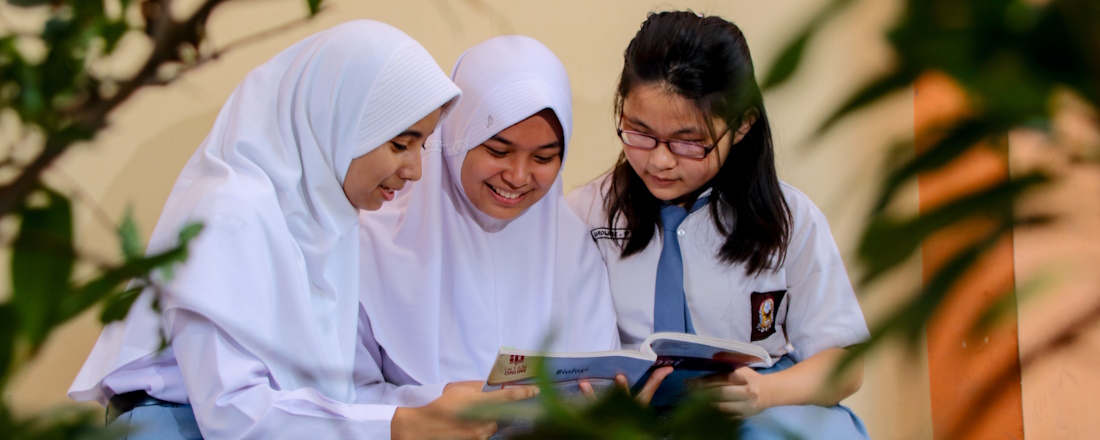
Public schools in Indonesia are administered by the local government and adhere to the national curriculum. The teaching language is Bahasa Indonesia, and local teachers teach every subject in it. Other indigenous languages are used in remote parts of the country.
The language barrier and inconsistent quality of public schools are the main reasons that expat children do not commonly attend public schools in Indonesia.
The challenges of Indonesian public education encompass the integration of modern teaching methodologies while maintaining traditional cultural values. The government continuously works to improve the quality of education through teacher training programmes and curriculum updates. Furthermore, many public schools are now trying to incorporate English as a second language in their curriculum to make students globally competitive.
Useful links
Private schools in Indonesia
Private schools in Indonesia value academic and non-academic achievement more equally than their public counterparts. They usually incorporate extracurricular activities, such as the arts and sports, to help students discover and hone their talents. Smaller class sizes in private schools allow for more individual attention.
Indonesian private schools generally offer a curriculum that both meets and exceeds the requirements of the Indonesian curriculum, sometimes taught in combination with the International Baccalaureate (IB). Many of these schools also teach in English.
Some private schools are affiliated with a religion (Islamic madrasahs, Catholic or Christian schools) and fall under the Ministry of Religious Affairs rather than the Ministry of Education. This is worth knowing when researching schools, as the oversight structure and curriculum emphasis can differ.
Most of these schools cater for Indonesian students, with international students often making up only a tiny proportion of the school's student body. Indonesian private schools do accept expat children, and these schools are a more affordable alternative to international schools for expats who work for companies that do not cover education fees.
Useful links
International schools in Indonesia

Most expats in Indonesia send their children to international schools. These schools offer a foreign curriculum and are officially accredited by the relevant authorities in their home country. Tuition fees at international schools can be extremely high and often increase with the child’s age or grade. Many international schools also charge a non-refundable annual capital fee.
In a bid to regulate the quality of education in Indonesia, the government has introduced legislation that no longer permits schools to use the word 'international' in their title to prevent low-quality schools from using the term merely to charge high fees. Most international schools are now classified as Satuan Pendidikan Kerjasama (SPK), which roughly translates to 'collaborative schools'.
SPK schools are required to teach Indonesian civics, history, religion, and language. In addition, they must allow Indonesian students to attend and employ local teachers to teach Indonesian subjects. Indonesian students at SPK schools are also expected to take national examinations at Grades 9 and 12, in addition to the school's own assessments. Foreign students are exempt from these exams.
Finding an international school
There are many options for international schools in Indonesia, catering to expat students from several countries, including the UK, the US, France, Germany, India, Japan, South Korea, New Zealand, Russia, and Singapore. Many of these schools also offer the International Baccalaureate (IB) programme alongside the sponsoring country's curriculum.
When considering international schools, parents researching education in Indonesia should consider the schools':
- accreditation,
- faculty qualifications,
- facilities,
- student-to-teacher ratio,
- and extracurricular offerings.
It's also beneficial to get feedback from other parents or attend open days to experience the school's environment firsthand.
Jakarta has the widest selection of international schools, but cities like Bali, Surabaya and Bandung also have a handful of well-regarded SPK schools. Families moving outside Java will find their options more limited.
International Schools in Jakarta
Useful links
Special educational needs in Indonesia
Children with special educational needs in Indonesia are served by two types of public schools: inclusive schools and extraordinary schools (Sekolah Luar Biasa, or SLB). Inclusive schools have a student body of special needs and mainstream students, while extraordinary schools are dedicated exclusively to students with special needs. Unless expat families already speak Indonesian fluently, most opt for private schooling for their children with special educational needs.
Some international schools can provide some limited specialised services for an extra fee, and this can be a good option for expat families.
Jakarta has the most SEN-equipped international schools. Families relocating to Bali, Surabaya or smaller cities should research SEN provision carefully, as options are more limited outside the capital.
Useful links
Tutors in Indonesia
Tutors in Indonesia have become increasingly popular, especially among expat families. They can be a great help in giving expat children a leg up as they adjust to a new school, especially if an unfamiliar curriculum or a new language is involved. Some expat families hire a tutor to help maintain a child's mother tongue or to help them learn and refine Indonesian or English quickly.
In the run-up to the final assessments, tutoring services for expats in Indonesia witness heightened demand as they are often hired to help students reach peak performance in the crunch period. Most tutors specialise in a particular subject, but some can help across the board, especially when it comes to teaching general essay writing and study techniques.
Online tutoring has grown sharply since 2020, and many expat families now use video-call platforms to access tutors from their home countries for specific curricula such as UK A-Levels or US SAT prep.