

The infrastructure for public transport and driving in the Czech Republic is excellent, making it easy for expats to get around. Public transport is robust and generally preferred, with a wide variety of options, including trains, subways, trams, buses, and taxis. Prague, in particular, has a well-integrated, easy-to-use public transport system and getting around is a breeze.
Public transport in the Czech Republic
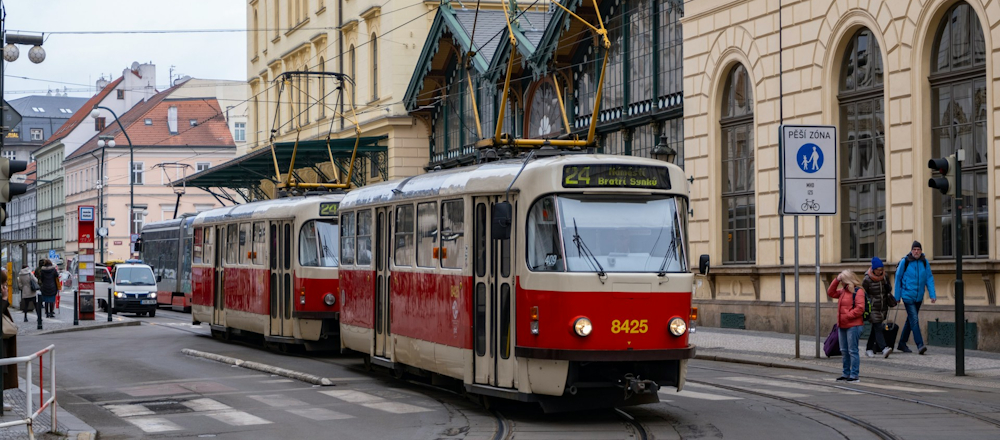
Trams
A number of Czech cities have tram systems, most notably Prague. In Prague, trams run 24 hours a day, seven days a week and are a quick way to get around, making them a popular mode of transport.
Trains
The national rail carrier is České Dráhy, and there are a few private rail companies in operation as well.
The largest and busiest railway station in the Czech Republic is Praha Hlavní Nádraží, in Prague. This station offers long-distance travel to several neighbouring countries (including Germany, Austria, Hungary, and Poland) and regional services to most large cities in the Czech Republic.
Metro
Prague is home to the country’s only metro system, which is popular among commuters and travellers alike. Continually expanding, the track is over 40 miles (65km) long, serving more than 60 stations.
Buses
If expats can’t find a train route to a city or village in the Czech Republic, then a bus will most likely get them there. In some cities, local buses are the preferred form of transport, running 24 hours a day.
Local and regional buses are usually run by the state, while services crossing over the border into other European countries are often run by private bus companies. There are currently over 60 bus companies operating in the Czech Republic, with more than 180 stations.
Useful links
Taxis in the Czech Republic
Taxis in the Czech Republic are infamous for taking advantage of foreigners. If expats cannot speak Czech, they should write down their destination to avoid a misunderstanding due to mispronunciation.
It’s best to arrange a taxi with a reputable company beforehand, but when hailing a taxi on the street, only use officially registered taxis and confirm the price before beginning the journey. These can be identified by their yellow roof lights. A taxi from a legitimate company will also have the company’s name, the taxi’s licence number and its rates printed on both doors.
Alternatively, ride-hailing apps such as Uber, Liftago and Bolt operate in the Czech Republic. Many expats prefer these apps because they offer greater control over routes and service prices while minimising language barriers.
Useful links
Driving in the Czech Republic

Road signs are mostly in Czech, and driving is on the right-hand side of the road. Cars in the Czech Republic must have their lights on at all times, and winter tyres must be used from November to March. Roads in the big cities are in good condition, but the trams, narrow streets and lack of parking might make a journey less than pleasant.
Like other EU countries, the Czech Republic uses a points system. Expats who receive 12 points for road violations will have their driving licences suspended for up to a year. Expats must also pay an annual toll for driving on Czech roads, which is paid by purchasing an electronic vignette.
Driver’s licences
Many expats will need to go through a lengthy process to legally drive in the Czech Republic, although there are exceptions. Those already licensed to drive in the EU can continue to do so using their current valid licence. In addition, certain countries have agreements with the Czech Republic that allow nationals to simply exchange their foreign licence for a local one.
That said, expats from non-EU countries without agreements with the Czech Republic will need to obtain a Czech driver’s licence. This can be a long and arduous process.
For the first three months of their residency, expats can drive on an International Driving Permit. To continue driving, they will need a Czech licence. To obtain one, expats must attend a local driving school for a prescribed number of hours and pass written and practical exams.