

Martha is almost 71 years old, and so this move has had its challenges for her. There are many cultural differences, and she has had to learn to just accept certain things that she doesn’t agree with. For many years, she had planned to live outside of the USA when she retired, but Brazil was not on her list of countries she wanted to move to. She had thought about Spain, Portugal, Uruguay, Peru, or Ecuador.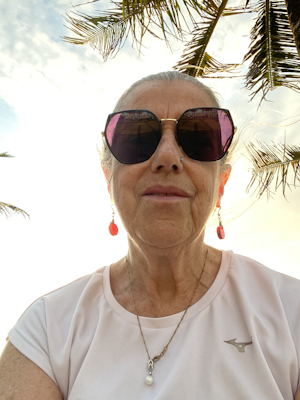
Martha has a background in social services and worked for various nonprofit agencies in Oregon, and ultimately ended up working with the Oregon Department of Human Services.
Martha likes animals, especially cats. She enjoys reading, cooking and baking, walking, hiking, doing arts and crafts, knitting and crocheting. She also likes to swim, and Brazil is a great place for that!
About Martha
Q: Where are you originally from?
A: The United States
Q: What country and city did you move to?
A: Aracaju and then recently to Estância in Brazil
Q: When did you move?
A: I moved to Aracaju in March 2003, and I am just completing construction of a home outside of Estância. My cat and I officially moved into the house a week ago. It is not completed, and so I have workers coming and going during the week.
Q: Is this your first expat experience?
A: Yes, although I was in the Peace Corps in Honduras from 1977 to 1979 and also lived in Chile teaching English from April 1981 to January 1986.
Q: Did you move here alone or with a spouse/partner or family?
A: I moved here alone, although my only son has lived here for 13 years. He is married to a Brazilian, and they have two children.
Q: Reason for moving?
A: To be with my son and his family. So, while I live here alone, Estância is only a one-hour drive. The house is at what is called a fazenda. It is a gated community with a large pool, barbecue areas, basketball courts and soccer fields. There is also a community garden and horse stables, and some cows and ducks.
Living in Aracaju and Estância
Q: What do you enjoy most about Aracaju, Estância and Brazil in general?
A: People are very relaxed and friendly. The country is beautiful, and the scenery is varied as the country is so large. The ice cream and gelato are delicious. The barbecue is traditional and very good. Many Brazilians like to walk for exercise.
Q: Have you had any low points? What do you miss most about the US?
A: Yes, of course, I have had low points. I tend to have some issues generally with being depressed at times. So, it is just worse here. However, now that I am in what I like to call “my forever home”, I am feeling better.
I do miss the northwest part of the USA. I grew up in the Midwest until the age of 16. I had never seen mountains until I was 14 years old, and the only time I ever saw the ocean was when I visited my aunt and uncle in Silver Spring, Maryland. So, imagine what it was like for me to move to Oregon. It is a beautiful state. So much good food grows in the Willamette Valley. I miss the Oregon berries!
I don’t particularly miss the city of Portland. While I appreciate the fact that Portland is a “green city” with a great recycling and composting system and that the parks are beautiful, the city has become too populated, congested and gentrified for my taste. I do miss having access to great restaurants with food from different parts of the world.
Of course, I miss family, friends and colleagues, too. It does help to have social media to stay in touch. There is nothing like being able to physically be with people.
Q: What misconceptions about Aracaju and Estância, if any, have you learned were not true?
A: I don’t think I had any misconceptions about Brazil before coming here. I came here with some idea of the culture, as I had lived in other countries in Latin America.
Q: What are the biggest adjustments you had to make when settling into expat life in Aracaju and Estância? Did you experience culture shock at all?
A: It has been difficult to learn to speak Portuguese, and I speak it with a Spanish accent. I do okay in one-on-one situations, but in group conversations, I tend to get lost. Brazil has a huge problem with garbage. There is garbage in all the neighbourhoods except the nicer ones and the tourist areas. While there is a law about littering, it is not enforced. A lot of people have dogs, and they do not pick up after them. Again, in the nicer and more expensive neighbourhoods, it is less of a problem.
Q: What are your favourite things to do on the weekend? Any particular places or experiences you’d recommend to fellow expats?
A: If you have the money and time, see as much as you can. There are so many places that I would like to see. So far, I have been to many places in the State of Sergipe, all of which have been interesting in unique ways. I have been to Recife, Maceió and various other towns and cities along the northeast coast. I have been to Belo Horizonte and Ouro de Preto in the state of Minas Gerais. I have been to São Paulo and Campos de Jordão. I have also been to Chapada de Diamantina in the State of Bahia. I have been to El Salvador numerous times. Travelling is wonderful.
Q: What’s the cost of living in Aracaju and Estância compared to the US? Are there specific things that are especially expensive or cheap there?
A: It is much cheaper in Brazil. However, cars and electronics are very expensive.
Q: What’s public transport like in Aracaju, Estância, and across Brazil?
A: Travelling by public transportation varied from city to city. There is public transportation in most cities. It is free to senior citizens if travelling within the city limits, and occasionally outside of the city to smaller towns.
Q: What do you think of the healthcare available in Aracaju and Estância? What should expats expect from local doctors and hospitals?
A: Brazil has the best public health system in South America. You can also pay for a private health plan or pay out of pocket. I had private health insurance for several months, but decided to cancel it because it was more expensive than I thought it would be. I use the public health system and pay out of pocket for some things. I do not have major health problems. I also did a lot of research about this.
In my opinion, there is not a whole lot of difference between public and private insurance. I think that 20 to 25 years ago, this was not the case, but private health insurance had become expensive, and you still have to wait sometimes for certain procedures or surgeries. Getting prescriptions is difficult compared to the USA. You have to get them renewed every month and in person in most places. Technology is improving. But it is still not anywhere as good as in the USA.
Q: What’s the standard of housing like in Aracaju and Estância? What different options are available?
A: Housing is inexpensive compared to the USA. If you have money, you can get into very nice places. There is a lot of poverty in Brazil, and poor people have a much lower standard of living than the middle and upper classes. In large cities, a lot of people buy apartments, but newer apartments tend to be very small. Older ones are larger.
Q: Are there any areas or suburbs you’d recommend for expats to live in?
A: It depends on what type of weather you like. The weather varies a lot from one area to another. I loved the climate in Minas Gerais and São Paulo. It was a little chilly early in the morning, but once the sun came out, it was beautiful.
Meeting people and making friends in Aracaju and Estância, Brazil
Q: Was meeting people and making friends in Aracaju and Estância easy? How did you go about meeting new people?
A: It was easy to meet people, as my son and daughter-in-law know a lot of people. Exercise classes for older adults were a good way for me to meet people my age.
Q: Have you made friends with locals, or do you mix mainly with other expats? What advice would you give to new expats looking to make friends with the locals?
A: I mostly spend time with locals or alone. Aracaju does not have as many expats as larger cities do. I am a pretty quiet and introverted person, so spending time alone is not a problem for me. I keep myself busy with different activities.
Working in Aracaju and Estância, Brazil
Q: How easy or difficult was getting a work permit or visa? Did you tackle the visa process yourself, or did you enlist the services of an immigration consultant?
A: I am retired, so I did not have to deal with this. However, my son and other people from the USA that I know did not have a problem with this.
Q: How does the work culture in Aracaju and Estância differ from the US?
A: I don’t know, since I don’t work. Brazil does have a lot of holidays, which is nice for those who do work.
Family and children in Aracaju and Estância, Brazil
Q: What are your favourite family attractions and activities in Aracaju and Estância?
A: I like the beach and barbecues at people’s homes. There are some nice museums where you can learn about the history and culture of the region. There are some good restaurants, although finding truly authentic food from other countries is difficult. They do have good sushi because Brazil has a large Japanese population. There is good pizza in a number of places.
Q: What are the schools in Aracaju and Estância like? Any particular suggestions?
A: Most people pay for private schools, as the public education system is not that good. If you do well enough on the entrance exams, you can get into the federal university system for free.
►Interviewed in December 2025