Print
  • Hold down Ctrl key and select the sections you want to print. If using a Mac, hold down the Cmd key.
  • Use Ctrl + A or on Mac, Cmd + A to select all sections (if you are using the Chrome browser).
  • Click "Apply" and the site will customise your print guide in the preview below.
  • Click the "Print" button and a print pop up should appear to print to your printer of choice.

Healthcare in Columbus

People in Columbus tend to find the same thing they find across the United States: the healthcare in Columbus is excellent, but it is expensive. The city’s hospitals are among the best in the Midwest, but you need insurance to get through the door. Medicaid and similar public programmes are available to lower-income residents, although the income limits are strict; many people earn too much to qualify and too little to cover private premiums without strain.

Take out a strong health insurance policy before you need it, so you can use Columbus hospitals and cover everyday medical costs. Most insurers have a list of approved providers, and some pay in full only at select hospitals and doctors’ offices. If you already have a hospital in mind, check those limits before you sign anything. Many employers pay for or subsidise part of their staff’s health insurance, so ask what your package includes.

Residents tend to say the big Columbus systems are all solid, and that the people on your care team matter more than the name on the building. The most common practical gripe is billing: surprise charges, and the gap between in-network and out-of-network care. Find out which hospitals and doctors your plan treats as in-network, and keep that list somewhere you can reach it.

Central Ohio has four major non-profit health systems: OhioHealth, Mount Carmel Health System, the Ohio State University Wexner Medical Center, and Nationwide Children’s Hospital. Our recommended hospitals in Columbus are listed below.

Healthcare and Health Insurance in the USA


Hospitals in Columbus

Nationwide Children’s Hospital

Website: www.nationwidechildrens.org 
Address: 700 Children’s Drive, Columbus, OH 43205

OhioHealth Riverside Methodist Hospital

Website: www.ohiohealth.com 
Address: 3535 Olentangy River Rd, Columbus, OH 43214

Ohio State University Wexner Medical Center

Website: www.wexnermedical.osu.edu 
Address: 410 West 10th Avenue, Columbus, OH 43210

Mount Carmel East Hospital

Website: www.mountcarmelhealth.com 
Address: 6001 East Broad Street, Columbus, OH 43213

OhioHealth Grant Medical Center

Website: www.ohiohealth.com 
Address: 111 South Grant Avenue, Columbus, OH 43215
Getting around in Columbus

Most new arrivals reach the same conclusion about getting around in Columbus: you will want a car. Columbus is also spread out, so most people drive to cover the distances between neighbourhoods. Without one, you are relying on buses, ride-hailing, bike and scooter hire, and an on-demand microtransit service.

Columbus has no trains or trams, and it is the largest city in the US without any rail-based transit. That is slowly changing. Under the voter-approved LinkUS programme, local authorities are building new bus rapid transit corridors to speed up cross-town journeys.


Public transport in Columbus

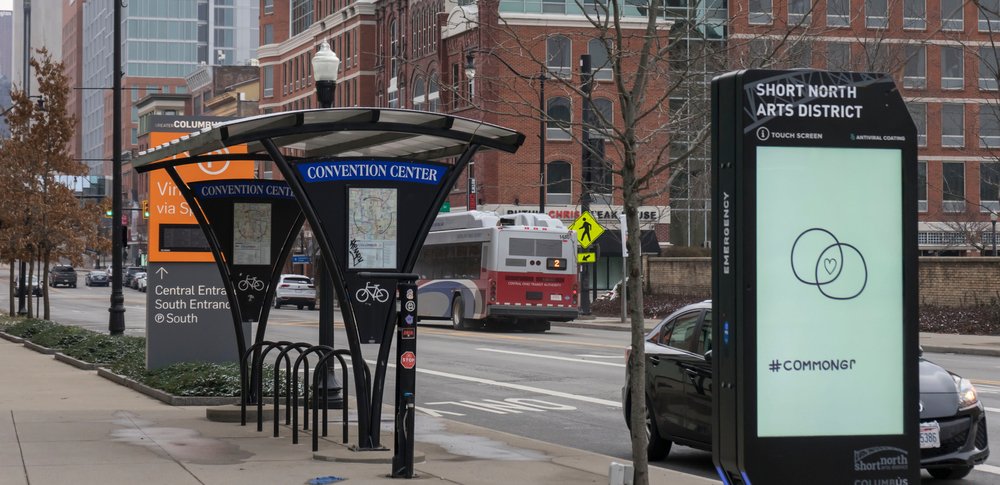
Convention Center Bus Stop in Columbus, Ohio, by Ci Ell on Shutterstock

Bus

The Central Ohio Transit Authority (COTA) runs the bus network. It operates around 40 routes and provides nearly 19 million passenger trips a year.

COTA also runs express routes, night services, an airport connector (AirConnect) to John Glenn Columbus International Airport, and on-demand COTA//Plus microtransit zones. Its CMAX line is a bus rapid transit route up Cleveland Avenue, and you can ride the free CBUS circulator around downtown and the Short North. Every COTA bus has free WiFi onboard. If you drive part of the way, you can leave the car at a COTA park-and-ride lot and finish the journey by bus.

You can pay by tapping a contactless card or phone, with a COTA smartcard, through the Transit app, or with cash on board.

Useful links


Taxis in Columbus

Taxis in Columbus are easy to find, but most new arrivals reach for a ride-hailing app instead. Uber and Lyft both operate throughout the city, but you can still book a traditional cab by phone or online if you prefer.

Useful links


Driving in Columbus

Time-lapse of Traffic at Front St Bridge, Columbus by RD Smith on Unsplash.

Driving in Columbus is the default for most new arrivals, and you will probably want your own set of wheels before long.

Driver’s licences

If you hold a driver’s licence from another US state or another country, you can usually drive on it while it is still valid. If your licence is not in English, get an International Driving Permit (IDP) before you move.

Once you become an Ohio resident, you will need to swap it for an Ohio driver’s licence at the Ohio Bureau of Motor Vehicles (BMV).

Useful links


Cycling in Columbus

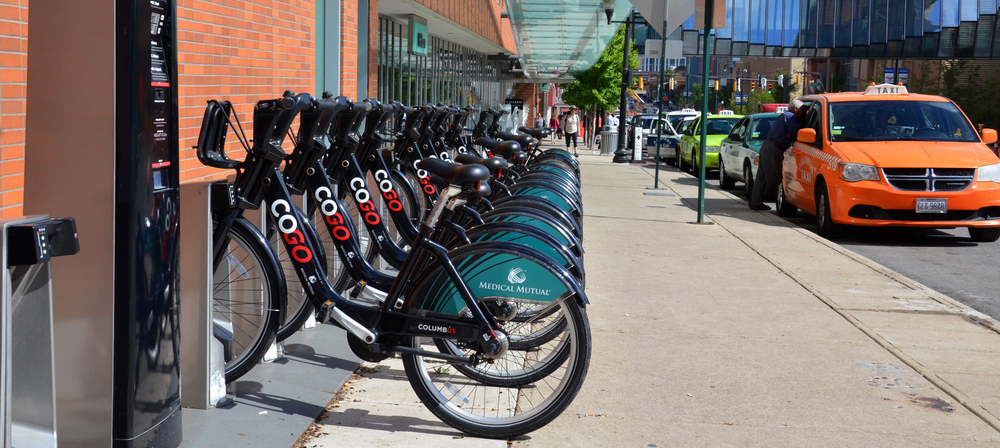
CoGo Bicycle Stand in Downtown Columbus by Susan Montgomery on Shutterstock

Cycling in Columbus is increasingly popular, and local authorities continue to add protected bike lanes and turn boxes to make the streets safer for riders. In 2024, the Columbus City Council approved the Bike Plus plan, a long-term blueprint for nearly 500 miles (800km) of new bikeways across the city.

If you are not ready to buy your own bike, the city’s shared mobility scheme has you covered. Veo runs the dockless bike and e-scooter hire across Columbus; you unlock a bike or scooter through the Veo app and leave it at a parking corral when you are done.

Useful links

Working in Columbus

Graduates and young professionals who are moving to and working in Columbus will find a fast-growing, diversified economy. Families settle here in large numbers too, and there is varied work to go around.

Several Fortune 500 companies are headquartered in the Columbus area. The insurer Nationwide, the utility American Electric Power, and the bank Huntington Bancshares all have their head offices downtown, and pharmaceutical distributor Cardinal Health is a short drive away in Dublin.

For people moving from abroad, the market itself is rarely the obstacle. The sticking point is the visa: for most jobs, an employer has to be willing to sponsor you.


Job market in Columbus

Downtown Columbus, Ohio skyline at sunset with the Scioto River pedestrian bridge in the foreground

Employers across finance, insurance, healthcare, and technology have kept the Columbus job market busy, and Ohio State University supplies them with a steady stream of graduates. Startups and technology firms have a real foothold here. Founders can tap the city’s incubators and a deepening pool of venture funding. Columbus is also within a day’s drive of roughly half the US population, so logistics and manufacturing employers cluster across the metro.

Employers hire across the spectrum, from sales associates and registered nurses to tech roles such as software developers and cybersecurity specialists. JPMorgan Chase is among the largest private employers in central Ohio, and hospital systems like OhioHealth and Ohio State’s Wexner Medical Center recruit year round.

Big employers have also moved into the suburbs. Amazon and Meta have built large data centres around New Albany, and Google and Intel are developing major sites nearby. These are long-term bets: few of the data centre jobs are permanent, and Intel’s chip plant is not due to begin production until the end of the decade. For now, most of the steady work tied to them is in construction and the supply chains that feed it.


Finding a job in Columbus

Most people finding a job in Columbus begin with the big online job boards, Indeed and LinkedIn chief among them. Between them, they list openings across every major industry, so it is easy to filter down to the work you actually want.

Networking matters here. Get to job fairs and the industry meetups that professional bodies run around the city. Local staffing agencies are another route, and many place people in both temporary and permanent roles.

Plenty of Columbus employers post vacancies straight to their own careers pages, so check the businesses you would most like to work for. Keep an eye on professional social media as well, LinkedIn most of all; recruiters often post there first, ahead of the big boards.

One thing to settle early: if you need a US work visa, check that an employer can sponsor you before you go too far down the road. See the visas and work permits guides below for the main routes.

Visas for the USA 
Work Permits for the USA

Useful links


Work culture in Columbus

Locals bring a relaxed, flexible style to the Columbus workplace, more laid back than you would find in the high-energy coastal cities. Columbusites are driven and ambitious all the same.

The city is also more international than newcomers expect. Columbus has one of the largest Somali communities in the United States, and its Asian and Latino populations keep growing. You will see that mix in offices and neighbourhoods across town.

Remote and hybrid arrangements are common across the city, and most employers expect to discuss them. A growing number of people move to Columbus while keeping a remote job with an employer elsewhere; the cost of living is lower than on the coasts, and that is a large part of the draw. The startup scene is strong too, and younger firms tend to compete on benefits and flexibility rather than salary alone.

Relationships are valued, and people prefer to solve problems together. As in any part of the USA, avoid sensitive subjects such as politics or religion at meetings or work gatherings.

Business Culture in the USA